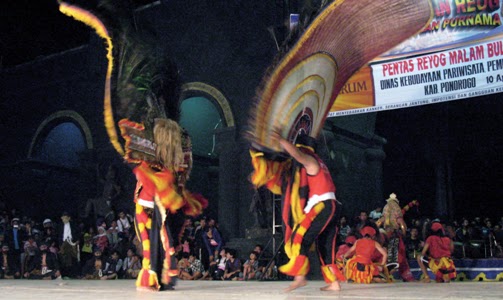
The Ponorogo Traditional Art carries out rich social and cultural tendencies.
The Reog spectacle held at a moonlight night, Friday (4/10) at Ponorogo city square bewitched over one thousand audiences. Tourists from Jakarta, Surabaya and the surrounding areas of Ponorogo looked enthusiastic in watching the dancer danced with peacock “dhadak” on the stage.
On Panjul’s head, a 50 pound “barongan” seemed to look light as feather. He danced and moved at every direction. Sometimes he bent backwards and stood back as quick as a lightning. He would lie on the floor and then stood up in a blink of an eye. On stage, Panjul and Kemek, the two dancers, fought like angry tigers. When fighting against Prabu Kelana Sewandana, the Barongan or Singobarong acted like an angry Javanese tiger trying to attack its prey. That night, Reog Sardula Seto group from Ngebel Ponorogo were demonstrating reog as they have for decades.
The sound of gamelan with pelog and slendro from kendang, gayor, kempul, and other various traditional music instruments added nuances to the spectacle. The sound of trumpet was audible from the beginning until the end. The movements of Jathilan dance, Warok, Bujang Ganong, and other actors were synchronous with the tunes of gamelan.
Each of the five players had their own character and uniqueness. Prabu Kelana Seandana was tall, athletic and handsome. His clothes were clean and glamorous. Of course, he was very powerful. However, his looks were unable to conquer the beautiful princess Kediri Putri Sangga Langir. Bujanganong was exactly the opposite of Sewandana. He was an uglymasked sorcerer. He had long hair and mustache, big eyes, wide mouth, large teeth and funny expression. Although the spectacle told the onesided love of Prabu Kelana Sewandanan, the one that bewitched the audience most was Singabarong. In order to be able to support the barongan, pembarong/barong dancer must rely on his neck muscle.
The stage side was filled with warok. They wore black clothes, had thick side hair and dark hat on their heads. White thongs tied on their mid. They danced in rigid movements, with measured steps. Jathilan appeared after the Warok dance. The dance lightened up the stage. Six beautiful girls with black and white clothes and perfume mounted “lumping horses”. Smile never left their lips for as long as they performed the seductive dance.
That night, the story being told was an official one. It went like this: Prabu Kelana Sewandana from the Kingdom of Bantarangin fell madly in love with Dewi Sanggalangit from the Kingdom of Kediri. He sent Patih Bujang Ganong to propose the princess. However, on his way to Kediri, Bujang Ganong was ambushed by Singobarung, a creature with the head of a lion and fur like that of peacock feathers. He fought and lost, and therefore made his way back to Bantarangin. Sewandana was furious because his emissary was beaten by Singobarong. Accompanied with Warok and Jathilan, he faced Singabarong. A battle of brawl, magic, and suddenly Singobarong tensed in agony. Samandiman arcane whip conquered Singabarong. From that moment, Singobarong followed Sewandono everywhere he went.
The victory was visualized through the parade of Sewandanan on stage, followed by Jathilan, Singobarong, Bujang Ganong and the warok. They headed back to Kediri. However, the meeting between Kelana Sewandono and Dewi Sanggalangit was not shown.
This was a free entertainment and a means of attracting tourists to Ponorogo. To this day, the Kingdom of Bantaringan’s real site was difficult to indicate, and the debates on whether it really existed or not remains. The 45-minutes spectacle ended with an inconclusive ending. After the show was over, the reog dance group hurried to go back home.
Although they appeared great on stage, they were not real reog players from Ngebel. Reog Sardula Seto did come from Ngebel, but most of the players on that night’s show were students of Universitas Muhamadiyah Ponorogo. They were hired by the District of Ngebel for that night’s show, because “Not all districts in Ponorogo has such a lively reog show,” said Shodiq Pristiwanto, a reog artist who graduated from Sekolah Tinggi Seni Indonesia Solo and the owner of Sumo Aglar Nuswantoro Ponogoro dance studio. Shodiq himself works in the Office of Culture, Tourism, Youth and Sports of Ponorogo Regency.
Not all 21 districts in Ponorogo are ready to hold reog show by the time their turn comes. Averagely speaking, a district gets its turn to hold reog show at Ponorogo square once every two years, despite the fact that those who perform on stage are experts on reog.
Since five years ago, the full moon spectacle has already been obligatory. Just like an obligatory ritual, the show goes on whether it’s raining or not. “We can fill the dancer roster by hiring amateurs. It’s better than having a half-hearted performance,” said Shodiq after the show.
Reog has three versions of origin: Bantarangin version, Ki Ageng Kutu Suryangalam (Ki Ketut Suryangalam) version and Batara Katong (Lembu Kanigoro) version. The first version mentions four actors in reog: Kelana Sewandana the King of Bantarangin, Patih Bujang Gabong, a number of soldiers (Jathilan) of the Bantarangin kingdom and Singaborong who ruled Lodaya jungle. The second version only knows three main characters: Bujang Banong, Singobarong and a number of cavalries (Jathilan). Bataro Katong version is much similar to the first version, with Ki Ageng Mirah – one of the trusted follower of Batoro Katong – changing barongan (before it changed its name into reog) with Ketut Suryongalam way and used reog to spread Islam on Wengker land in the 15th century. Since old times, Reog has been an effective means of gathering the people.
Out of the three versions, Ki Ketut Suryangalam’s version is probably the most interesting one. At the end of 1400s, the kingdom of Majapahit, the largest single Buddhist Kingdom ever existed in Indonesia which had its center in Trowulan, Mojokerto, was falling down out of weak leadership and the ever strengthening influence of Islamic Kingdom of Demak. Some of Majapahit’s territories threatened to separate themselves from Majapahit. It was at those down times that Bre Kertabhumi, the last king of Majapahit with his official title of Brawijaya V, proposed marriage to Princess Campa from Tiongkok. The moslem girl from Tiongkok became one of his five wives and was known to be the most beautiful among those wives. It was said that Princess Campa was responsible for the decision of Brawijaya V to convert to Islam.
Ki Ketut Suryongalam, a poet from Majapahit who constantly gave advices to the king, was worried with how things were going. The King barely noticed his words anymore. Ketut Suryongalam saw that the developing Islamic Demak, along with Islamic teachers who were spreading the religion across Java, were serious threats to the Kingdom of Majapahit. However, blinded by his beautiful wife, the King instead saw Suryangalam’s words as false accusations. Brawijaya V was controlled by Princess Campa, who indeed was assigned a task to convert Majapahit into Islamic kingdom by Demak. Unfortunately, Princess Campa had a great influence in the kingdom’s policies.
Fifteen years before the Kingdom of Majapahit was destroyed, Suryongalam who originated from Bali and was a follower of Budha Tantrayana left the kingdom without saying goodbye. His destination was Kutu (now the District of Jetis, Ponorogo). At that time, Kutu was within the territory of Wengker, southeast of Gunung Lawu. There he built Kademangan Kutu. In order to develop a resistance community, he built a buddhist monastery which taught wizardry and the knowledge about life. Through this monastery, he recruited local youths and hoped to rebuild the glory of Majapahit. The students were then called warok. It was the origin of the rebellion for Majapahit.
At this time Suyongalam started to organize resistance against Brawijaya V whom he considered too weak to fight Demak. He created a popular art. “He created an art motivated by criticism towards the king,” said Murdianto, culture researcher for the Institute Institute for Religion dan Cultural Studies (IRCaS) of Ponorogo.
Barongan is what Surangalam created. All of the players are male. At that time, the music was made out of bamboo beat instruments. This art combines various types of art: mask arts (visual arts), dance, music and vocal arts. Mask arts can be traced back to Bali, Banyuwangi, Solo, Yogyakarta, as well as Indramayu. The critics are not delivered in the form of narration or song, but instead symbolization of Barongan, Bujang Ganong (Ganongan), and Jathilan. Barongan, said Ahmad Tobron Torejo, 72 years old, a reog artist from Sumoroto Ponorogo – became a criticism towards the king who was too busy in dealing with his own personal life and ignored his people.
Barongan was made from the head of a lion and peacock feathers. The beautiful peacock feathers were spread out to form an almost oval sheet. The head of the lion represents Brawijaya V and the peacock feathers, the lovely Princess Campa. The peacock above the lion’s head is a concealed sarcasm towards Brawijaya V who submitted to Princess Campa’s will. “The King lives below the Queen’s armpit,” said Murdianto.
Suryongalam himself is shown as Ganongan. Although ugly, he possesses courage and determination. Two male Jathilans dressed up as women illustrate feminine and seductive cavalries, representing Majapahit soldiers who fought like girls, too scared to attack Demak. It can also be interpreted as soldiers who lost their noble soul and patriotism and turned to vanity like women.
In his small book which discussed the origin of reog Ponorogo, late Reog Ponorogo practicioner KH Mujab Thahir, caretaker of Al-Idris Religious Boarding School in Ponorogo, noted that Barongan is also a means of entertaining the people around the monastery and channeling the sexual passion of Suryongalam’s male students to handsome children acting as Jathilan.
There is a certain reason behind the sexual management of the waroks. Suryongalam said that waroks should not commit sexual intercourse with women. This restriction was imposed for several years as long as the lesson is not complete yet. The sperm ejected when having sexual intercourse with female is believed to weaken the supernatural power of the students. In return, the men had with them adolescent boys known as gemblak. This tradition has been carried out for centuries until after the Independence of Indonesia. Gemblakan – those who were kept for sexual entertainment for waroks – became Jathilan in the reog spectacle.
Ahman Tobroni has his own theories about this teaching. In terms of sexual management, he compares warok to that of an athlete. If an athlete wants to compete, he can’t have sex because it will consume his energy. “Waroks take care of many things. This is a way to maintain their stamina,” he said.
This is the origin of warok-gemblak relationship which incorporates same-sex male relationship. “However, they are not homosexuals like many people accused them to be,” said Ahmad Tobron.
This issue has been long debated. Many artists consider it to be the truth, while others see it as something in the past or simply reject the accusations concerning homosexuality. However, words spread accross Ponorogo that same-sex love indeed happen. “If they resort to intimate intercourse, I think they only go as far as hugs,” said Tobron.
Tobron himself became a gemblakan for late Mbah Mardi, a warok in Jetis, Ponorogo, in the 1950s when he was in Junior High School. Apart from being a Jathilan in reog spectacles, he lived a fun after-school life. In the afternoon he would be taken for a bicycle and eating boiled peanuts or dawet at the square, and for a movie at night at Ponorogo cinema. “Afterwards I would be dropped home at my parents’ house. I was the son of a rich man,” he said. He went to school at Mbah Mardi’s expense. Such pattern, said Tobron, is similar to that of fostership. By the time he finished Junior High School, he no longer became gemblakan because he continued his study in Malang. Later, when Tobron owned his own reog group, he cared for four gemblaks. He paid for their school and now they’ve all became successful. “I treated them the way Mbak Mardi treated me as his gemblakan,” he said.
Indri S Priyono, 44 years old, former gemblakan for a warok in Sumoroto in mid 1970-s said that usually one reog group can have up to three gemblaks. He first became gemblak when he was in 6th Elementary grade and during his Junior High School years. At that time, he was a handsome child. “A warok cannot afford too many gemblaks because each year a gemblak gets a calf. A calf worth a fortune in those days,” he said.
As long as he became gemblakan, said Indri, he spent the nights at the houses of sinomans in turns. They would organize the sleeping schedule for each gemblakan. Sinoman are young members of the reog group. “At that time, sexual intercourse between males only involve grinding inbetween legs,” said Indri, who are now working as bridal makeup artist in Jetis, Ponorogo. He chose not to be married and prefers to hang around with the community of homosexuals in Ponorogo.
Tobron did not deny that having gemblakan is a part of raising one’s social status. Generally waroks are rich. Apart from having reog group of their own, they also possess great influence over the people. Until the mid 1970s, lots of waroks own more than one gemblakan. “More gemblakan means more respect among the reog artists’ community,” said Tobron.
Indri said that to warok, gemblak is “a child as well as a wife”. The handsome boys become lovers as well as sex partners to gemblaks. At the end of the traditional days, gemblaks still received payments in the form of calf, money or school fee.
History has shown that waroks are ambigues socialites. On one side, they are referred to as honorable members of society for their wealth and supernatural powers. On the other side, they are viewed negatively for their masochist, mob-like, characteristics and their gemblakan tradition. Until the mid 1970s, waroks are usually owners or sponsors of reog groups. They are not a part of reog dancer team. The inauguration of warok is a natural process carried out by a community. Like that of a kiai, warok is inaugurated by the people.
According to Ahmad Zainul Hamdi, Ponorogo transexual researcher from GAYa Nusantara Surabaya Institute, waroks are highly possessive towards their gemblaks. “competition between waroks over gemblak often caused violent and even fatal conflicts. Often, a gemblak has to be carried everywhere for fear of being kidnapped by competing waroks,” he said.
It was also common, said Zainul, that a gemblak is murdered because he was found cheating with another warok. Therefore, in order to “officially state” a child to be a warok’s gemblak, a reception ritual is carried out as a means to avoid social conflicts among the reog community.